
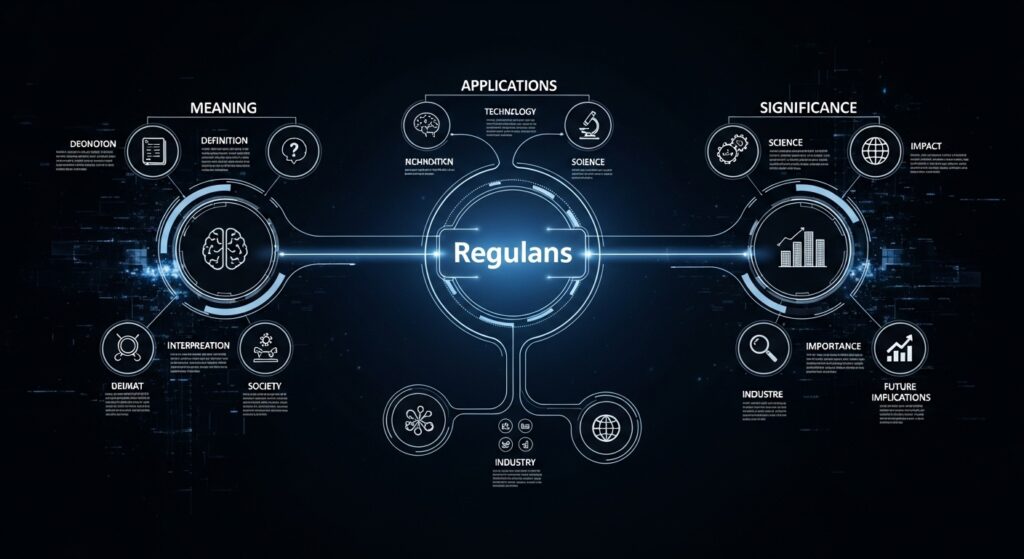
Regulans is a term that has begun to appear in discussions across various professional and academic contexts. While it may sound unfamiliar, the concept behind regulans often relates to systems of regulation, guidance, or control in both technical and social environments. Whether in organizational frameworks, scientific discussions, or digital systems, regulans emphasizes structure and the importance of consistent processes. Understanding regulans helps readers appreciate how rules, patterns, and mechanisms function to maintain balance and efficiency. The meaning, applications, historical context, and modern relevance of regulans in multiple fields, providing insight into its significance today.
Defining the Concept of Regulans
At its core, regulans refers to an element that directs, controls, or organizes within a system. The term is derived from Latin roots that imply regulation and order. In practical terms, regulans can be applied to systems that require structured guidance, such as organizational policies, scientific processes, or technological frameworks. By providing consistent control, regulans helps ensure efficiency and predictability. Understanding this concept allows individuals to see how systems maintain stability and adapt to challenges. Whether applied in professional settings, research, or digital environments, regulans represents the principle that structure and guidance are essential for optimal performance and reliable outcomes.
Historical Background of Regulans
The concept of regulans has roots in historical discussions about governance, law, and order. Ancient scholars often emphasized regulation as a necessary component of organized society, linking it to fairness, efficiency, and predictability. Over time, the term evolved to encompass broader applications beyond legal frameworks, including organizational management and scientific methodology. Regulans has been referenced in various academic texts to describe mechanisms that maintain balance within complex systems. Studying its historical context provides insight into how structured approaches to control and guidance have shaped human understanding of processes, whether in societal, scientific, or technological domains.
Regulans in Organizational Management
In organizational settings, regulans often refers to policies, procedures, or frameworks designed to maintain order and efficiency. Businesses and institutions rely on structured systems to coordinate activities, allocate resources, and ensure accountability. By applying the principles of regulans, managers can guide operations, mitigate risks, and optimize outcomes. This structured approach enables teams to work cohesively while maintaining compliance with internal and external standards. Regulans in management is not only about rules but also about creating systems that adapt to change while sustaining performance. Organizations that effectively implement regulans tend to experience greater stability and improved operational results.
The Role of Regulans in Scientific Research
Scientific research often involves complex systems that require consistency and precision. Regulans plays a critical role by ensuring processes are standardized and results are reproducible. Experiments, data collection, and analysis rely on regulated protocols to maintain accuracy. By incorporating regulans into research methodology, scientists can minimize errors, maintain objectivity, and validate findings across studies. This principle applies in laboratory work, clinical trials, and observational studies. Understanding regulans in science highlights the importance of structure and control in advancing knowledge and achieving reliable outcomes, ensuring that discoveries are credible and applicable across various contexts.
Technological Applications of Regulans
In modern technology, regulans refers to systems designed to maintain control, optimize performance, and ensure consistency. Software platforms, automated systems, and digital frameworks rely on regulatory mechanisms to function efficiently. Regulan can manifest in algorithmic controls, security protocols, or operational monitoring systems that maintain stability and predictability. By implementing regulan principles, developers and engineers can ensure systems respond appropriately to different conditions while minimizing errors or disruptions. This concept emphasizes that technology, while advanced, depends on structured guidance and regulatory processes to maintain efficiency, accuracy, and user satisfaction in an increasingly digital environment.
Regulans and Legal Frameworks
The term regulan also has relevance in legal contexts, where it can describe mechanisms that ensure compliance and order. Laws, regulations, and organizational policies serve as forms of regulan that maintain societal balance and fairness. By providing guidance and enforceable rules, legal systems use regulan to structure behavior, protect rights, and prevent conflicts. Understanding regulan in law highlights the importance of consistency and clarity in maintaining social stability. Legal frameworks that implement these principles effectively help communities function smoothly while providing mechanisms to resolve disputes and uphold accountability across various institutions.
Benefits of Applying Regulans Principles
Applying regulans principles across disciplines offers multiple benefits. Systems guided by regulan tend to be more organized, predictable, and efficient. In organizations, this approach improves productivity and reduces miscommunication. In scientific research, it ensures accuracy and reliability of results. In technology, regulan maintains system stability and enhances performance. Across legal and societal frameworks, it fosters fairness and consistency. These advantages demonstrate that structured guidance is essential for managing complexity, reducing errors, and creating reliable outcomes. The overarching benefit of regulan lies in its ability to provide order and structure while allowing systems to adapt to changing conditions effectively.
Challenges in Implementing Regulans
Despite its benefits, implementing regulan can present challenges. Systems that are overly rigid may struggle to adapt to dynamic environments, while insufficient structure can lead to inefficiency or inconsistency. In organizations, poorly designed regulan can cause confusion or stifle innovation. In scientific and technological contexts, failure to apply regulan accurately can compromise reliability and performance. Addressing these challenges requires careful planning, clear protocols, and ongoing evaluation. Effective implementation balances structure with flexibility, ensuring that systems guided by regulan remain adaptable, efficient, and capable of meeting evolving demands without compromising stability or quality.
The Future Significance of Regulans
As systems across society, science, and technology grow increasingly complex, the importance of regulan continues to expand. Future applications may involve more sophisticated regulatory frameworks driven by artificial intelligence, automation, and global collaboration. Implementing regulan principles in these contexts can enhance efficiency, reduce errors, and maintain predictability in large-scale operations. Understanding its relevance prepares individuals and organizations to manage complexity effectively while embracing innovation. The evolving role of regulan demonstrates that structured guidance, whether in digital, organizational, or societal systems, remains crucial for achieving sustainable and reliable outcomes in an increasingly interconnected world.
Conclusion
Regulans represents the principle of structured guidance, control, and consistency across multiple domains. From organizational management and scientific research to technology and legal frameworks, its applications help maintain order, efficiency, and predictability. Understanding regulan provides insight into how systems function reliably and adapt to changing environments. While challenges exist in implementation, its benefits in reducing errors, optimizing processes, and supporting stability are clear. As modern systems continue to grow in complexity, regulan will remain an essential concept, emphasizing the importance of structured approaches in achieving sustainable, effective, and well-regulated outcomes.