
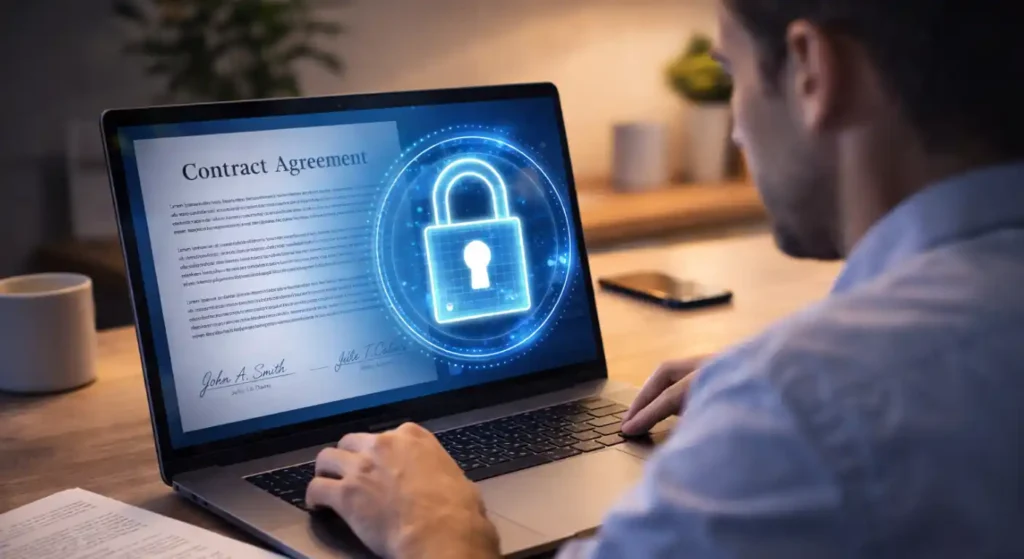
Something quietly changed in the way the world does business last year, and most remote workers either missed it or felt its effects without quite knowing why. Contracts got harder to sign across state lines. Onboarding processes for freelancers in regulated industries added extra verification steps that didn’t exist in 2024. Background check portals now ask for proof of identity that goes beyond a scanned driver’s license. None of this was accidental.
These changes trace back to a wave of digital identity legislation that swept through several U.S. states between late 2024 and early 2026. The underlying premise is straightforward: as more transactions move permanently online, the legal infrastructure around them has to catch up. But the implications for the remote workforce are anything but simple.
Decentralized Identity and the Collapse of the Physical Signature
For centuries, a signature meant something specific: ink on paper, witnessed by someone physically present. That model started eroding with DocuSign and its competitors, but the 2026 regulatory cycle has effectively buried it. Under the new frameworks, a valid digital signature is treated as a cryptographic event — a time-stamped, device-bound, chain-of-custody record that’s more verifiable than any wet ink mark ever was.
The shift toward self-sovereign identity (SSI) protocols and verifiable credentials (VCs) means that individuals now carry portable, cryptographically signed proofs of who they are. These proofs are issued by accredited parties, stored in digital wallets, and presented without ever exposing the underlying document. It’s a system that is simultaneously more private and more secure than what it replaced — but it requires trusted validators at key points in the chain.
Why Utah Is Running the Playbook Everyone Else Is Copying
Among the states that have moved aggressively on digital identity legislation, Utah stands out. The state has built a reputation for treating legal tech as economic infrastructure rather than bureaucratic overhead. Its Utah Division of Professional Licensing (DOPL) has steadily expanded the legal scope of Remote Online Notarization (RON) since 2019, and the 2026 updates pushed that framework to a new level of technical rigor.
What makes the Utah model notable is its specificity. Rather than issuing broad mandates, the state has published detailed technical standards for identity proofing, credential analysis, and platform security. The result is a notarial role that looks almost nothing like the stamp-and-sign function most people still picture. A Utah Notary in 2026 is, in practice, a credentialed operator working within a layered digital trust architecture.
United Flight UA195 Diversion Halifax: What Passengers Need to Know
The Human Firewall: What the Modern Notary Role Actually Demands
The phrase “human firewall” has been circulating in cybersecurity circles for years, but it applies with unusual precision to what a RON-commissioned notary now does. They are the last human checkpoint before a high-value transaction becomes legally binding. Their job is to verify identity in real time, detect coercion or incapacity, confirm document integrity, and leave a tamper-evident audit trail — all within a video-based session that may involve signatories in multiple time zones.
The “signature” has changed from a physical mark to a cryptographic event in the decentralized digital economy of 2026. The Utah Notary, who now acts as the final arbiter of remote transactions, has gained fresh attention as a result of this change. But this greater digital capability also means a much more technical state assessment. It takes active situational testing to grasp the subtleties of the 2026 Utah Notary laws, not just reading the manual. Candidates can experience high-stakes digital verification scenarios by taking a specific Utah Notary practice test, which guarantees they have the technical accuracy needed to function as a secure gatekeeper in the contemporary remote marketplace.
A Side Hustle With Structural Demand
A notary commission is one of the only credential-backed revenue streams that can grow without increasing overhead for remote workers who are already engaged in the digital economy. A webcam, compatible software, and a secure internet connection are the only equipment needed. The client base, however, is enormous: real estate transactions, estate planning documents, business incorporation filings, and cross-border employment agreements all require notarization, and a growing share of that demand is being routed through RON-qualified practitioners.
The real catch is how hard the exam has become. Utah has updated the process to be more technical. To pass, you need to truly understand identity verification and the new legal requirements. Those who don’t take the exam seriously usually fail.
The Infrastructure Opportunity Nobody Is Talking About
The conversation around remote work in 2026 has been dominated by AI automation and the fate of knowledge workers. That’s a legitimate discussion. But underneath it, a quieter transformation is taking place in the legal and identity infrastructure that makes remote commerce possible. The people who understand that infrastructure — and hold the credentials to operate within it — are positioning themselves at the center of every serious digital transaction.
The gatekeepers of the new digital economy are not algorithms. They are credentialed humans who know exactly where the law draws the line — and why that line exists. The question is whether you want to be on the other side of that gate, or the one holding the key.