
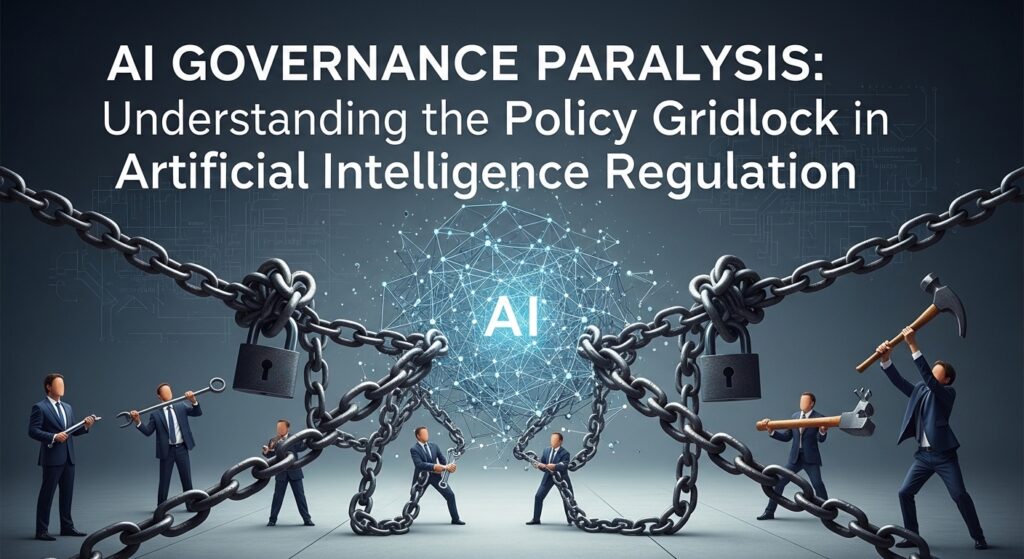
Artificial intelligence is advancing at an extraordinary pace, transforming industries, economies, and everyday life. Yet while innovation accelerates, regulation often struggles to keep up. This imbalance has led to what many experts describe as AI governance paralysis, a condition where policymakers hesitate, delay, or remain divided on how to regulate emerging technologies. The consequences of inaction can be significant, affecting privacy, security, and public trust. At the same time, overly restrictive policies may hinder innovation. Understanding AI governance paralysis requires examining political, technological, and global factors that contribute to regulatory uncertainty in the digital age.
Defining AI Governance Paralysis
AI governance paralysis refers to the stagnation or slow progress in creating effective regulatory frameworks for artificial intelligence systems. Governments recognize the transformative power of AI but often face uncertainty about how to manage its risks and opportunities. This hesitation can result from conflicting priorities, limited technical expertise, or fear of stifling innovation. As AI technologies become more complex, lawmakers may struggle to design adaptable policies. The result is a regulatory gap where innovation moves forward without clear oversight. AI governance paralysis highlights the tension between rapid technological development and the deliberate pace of policymaking.
Rapid Technological Growth Outpacing Regulation
One major driver of AI governance paralysis is the speed at which artificial intelligence evolves. Machine learning models, generative systems, and automation tools are introduced at a pace that traditional legislative processes cannot match. Policymakers often rely on extended consultations and debate, which can take years. Meanwhile, companies deploy new AI applications globally within months. This mismatch creates uncertainty about which technologies require oversight and how regulations should be structured. Without timely updates, existing laws may become outdated. The rapid growth of AI intensifies the challenge of designing effective governance structures.
Political Divisions and Competing Priorities
Political disagreement is another factor contributing to AI governance paralysis. Lawmakers may hold differing views on data privacy, innovation incentives, and national competitiveness. Some prioritize economic growth and technological leadership, while others focus on consumer protection and ethical safeguards. These competing priorities can stall progress on comprehensive legislation. In democratic systems, consensus building is often necessary before policies can advance. When agreement proves difficult, regulatory efforts slow down. AI governance paralysis emerges when political divisions prevent coordinated action, leaving businesses and citizens without clear guidance on responsible AI development.
Ethical Concerns and Regulatory Complexity
Artificial intelligence raises complex ethical questions related to bias, accountability, and transparency. Addressing these concerns requires careful analysis and multidisciplinary input. Regulators must consider how algorithms affect employment, decision making, and civil rights. Crafting laws that address fairness without imposing excessive restrictions is challenging. This complexity can lead to cautious approaches that delay concrete action. AI governance paralysis often reflects the difficulty of translating ethical principles into enforceable rules. Policymakers must balance moral considerations with practical implementation strategies to ensure regulations remain both effective and adaptable.
Global Competition and Regulatory Hesitation
AI development is closely tied to global competition among nations. Countries seek technological leadership to strengthen economic and strategic positions. In this environment, governments may hesitate to introduce strict regulations that could slow domestic innovation. This competitive pressure contributes to AI governance paralysis, as policymakers fear losing advantages to more permissive jurisdictions. At the same time, inconsistent regulations across borders create challenges for multinational companies. International cooperation becomes essential, yet reaching agreements on shared standards is complex. Global competition therefore both motivates and complicates regulatory efforts.
Impact on Businesses and Innovation
The absence of clear regulatory frameworks can create uncertainty for businesses. Companies developing AI systems may struggle to anticipate future compliance requirements. This unpredictability can delay investments or encourage cautious product development. AI governance paralysis may also affect startups that lack resources to navigate evolving legal environments. Conversely, minimal oversight might expose organizations to reputational or legal risks if harmful outcomes occur. A stable regulatory landscape supports responsible innovation by clarifying expectations. When paralysis persists, both established enterprises and emerging innovators operate in an ambiguous environment that complicates strategic planning.
Public Trust and Social Implications
Public confidence in artificial intelligence depends partly on effective governance. When citizens perceive that technologies operate without oversight, trust may decline. AI governance paralysis can fuel concerns about privacy, misinformation, and automated decision making. Transparent regulations reassure users that safeguards are in place. Without such measures, skepticism may grow, potentially limiting adoption of beneficial AI solutions. Governments play a key role in fostering trust through clear communication and balanced policies. Addressing governance paralysis is therefore not only a legal issue but also a social necessity that influences how communities embrace technological progress.
Paths Toward Overcoming Governance Paralysis
Addressing AI governance paralysis requires collaboration between governments, industry leaders, researchers, and civil society. Policymakers can adopt flexible frameworks that evolve alongside technological change. Regulatory sandboxes, advisory councils, and public consultations help gather expertise and test solutions. International dialogue also supports harmonized standards that reduce fragmentation. Education and capacity building within government institutions strengthen understanding of complex AI systems. By promoting transparency and shared responsibility, stakeholders can move beyond gridlock. Proactive engagement encourages timely action while preserving space for innovation and ethical oversight.
The Future of AI Regulation
The future of artificial intelligence depends on balanced and forward looking governance. Overcoming AI governance paralysis will require commitment to adaptive policy design and global cooperation. As technologies become more integrated into healthcare, finance, and public services, clear regulatory frameworks will grow increasingly important. Governments must remain responsive to emerging risks while supporting innovation. A dynamic approach ensures that policies evolve rather than stagnate. By learning from current challenges, policymakers can develop governance models that encourage trust, protect citizens, and sustain technological advancement in a rapidly changing world.
Conclusion
AI governance paralysis reflects the tension between rapid innovation and cautious policymaking. Political divisions, ethical complexity, and global competition all contribute to regulatory delays. However, the need for balanced oversight is essential for maintaining public trust and supporting sustainable growth. Through collaboration, adaptive frameworks, and international cooperation, stakeholders can overcome paralysis and create effective governance structures. By addressing these challenges thoughtfully, societies can harness the benefits of artificial intelligence while minimizing risks and ensuring responsible development for future generations.